
Is Your Money Safe in a Transfer App? Safeguarding Explained
By RemitInsights Editorial · Updated 17 November 2026 · 6 min read

Think about what happens between pressing “send” and your family receiving the money. For a little while, your money sits with a company, and in many cases that company is a payment app, not a bank. So what happens if it gets into trouble?
The answer is a rule called safeguarding, and in the UK it got tougher on 7 May 2026. Here is the plain-English version.
How safeguarding works
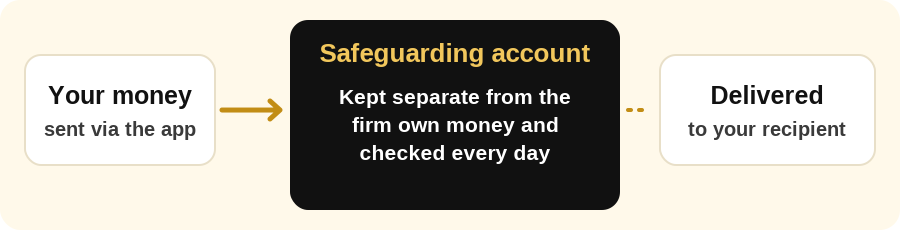
Customer money has to be kept apart from the firm’s own funds, for example in a special account at a bank. If the firm fails, that money is meant to go back to customers instead of being swept up by the company’s creditors.
A simple way to picture it
Imagine you ask a friend to hold your cash for an hour while you run an errand. If your friend tips it into their own wallet with their rent money and then loses the wallet, you have a problem. Safeguarding is the rule that says: keep it in a separate envelope with your name on it. If the friend goes broke, the envelope is still yours.
The two ways firms protect your money
In the UK, payment and e-money firms generally safeguard customer funds in one of two ways. Under the segregation method, they place customer money in a separate account, or invest it in approved low-risk assets, held apart from the firm’s own funds. Under the insurance or guarantee method, they arrange a policy or guarantee from a suitable institution that would pay what is owed to customers if the firm fails. Some firms use a mix of both.
The newer UK rules, covered in the next section, aim to make sure the right amount is protected at all times and that problems are spotted early.
What changed on 7 May 2026
The Financial Conduct Authority (FCA) strengthened the rules for payments and e-money firms. In short:
- Firms must check every day that the right amount of customer money is safeguarded.
- They must send the FCA a monthly safeguarding return.
- A named person must have oversight of safeguarding.
- Most firms must arrange an annual safeguarding audit. Small payment institutions are outside the audit requirement but can opt in.
- The FCA plans to review how the new regime works.
What “regulated” really means
Firms need permission from the FCA to offer payment services, either as an authorised firm or as a smaller registered one. Some apps work through agents or partners, so the company you see may not be the one holding the money. Checking the register takes two minutes and is worth it.
What safeguarding does not do
- It is not bank-style insurance. Money held by payment firms is still not protected by the Financial Services Compensation Scheme.
- It does not protect you from scammers. Safeguarding covers a firm failing, not you being tricked into paying the wrong person.
- It does not promise speed. If a firm fails, getting money back can take time.
What happens if a firm fails?
In broad terms, an insolvency practitioner takes over, works out how much customer money was safeguarded, and returns it to customers. This can take time, and the exact process depends on the case. The new rules aim to make the money easier to identify and return.
How to check a provider in two minutes
- Search the firm’s name on the FCA Register.
- Check that it is authorised or registered for payment services, and read its status.
- If you use an agent or a partner app, check that it is listed as an agent or is the firm itself.
- Beware of copycats. Use the contact details shown on the register, not those in an advert.
Habits that help
- Send money soon after you top up. Do not leave large balances sitting in an app for months.
- Keep your receipts and confirmation messages.
- Use strong, unique passwords and two-step verification.
- Stick to regulated providers and use the official app or website.
Common myths
- "Regulated means risk-free." Regulation lowers risk. It does not remove it.
- "My money is insured like a bank deposit." Not for payment firms in the UK.
- "Only small apps can fail." Size is not a guarantee, which is why the rules apply to every firm.
Questions worth asking a provider
- Which regulator authorises you, and what is your registration or reference number?
- How do you safeguard customer money: segregated account, insurance or both?
- Is the money I leave in the app protected the same way as the money in transit?
- What happens to my balance if you stop trading?
- Do you work through agents or partners, and who holds the money at each step?
A transparent provider will answer these clearly on its website or by customer support. Vague answers are a signal to compare other options. Our hidden fees guide shows the other half of choosing well: price.
Red flags in a provider’s disclosures
- No mention of safeguarding at all.
- Vague language about "protecting funds" with no method.
- No regulator reference number.
- Large balances encouraged with no explanation of protection.
Safeguarding in other regions
The idea is similar elsewhere, but the details differ. In the European Union, payment institutions must protect customer funds, either by keeping them separate from their own money or by holding insurance or a comparable guarantee. In the United States, money transmitters are licensed state by state, and states set rules such as surety bonds and limits on what a firm may invest customer money in.
Do not assume that a balance in a payment app has the same protection as a bank deposit. Check the provider’s own statement and your regulator’s guidance. In every country, look for a licence, a clear description of how funds are protected and an official register you can search.
If you do not live in the UK, check your own regulator.
Case study: when a firm fails
Illustrative scenario. This is a composite example. It does not describe a real person or company.
A small payment app serving workers who send money home runs into financial difficulty and stops trading. Customer balances are frozen while an insolvency practitioner takes control. Because the firm kept customer money in a separate safeguarding account and reconciled it daily, the practitioner can quickly identify what each customer is owed. Customers still wait for the process to finish, and some costs come out of the pool, but most of their money is returned.
Now consider a second firm that mixed customer money with company funds and kept incomplete records. Working out who is owed what takes much longer, and customers face far more uncertainty. The lesson: how well a firm keeps records and separates money matters as much as the rule itself.
What customers should do if their provider fails
- Do not send further payments through that provider.
- Look for official announcements from the regulator and the insolvency practitioner, and use only the contact details they publish.
- Gather your records: account details, receipts and transaction history.
- Submit any claim form on time through the official process.
- Be careful of scams: criminals often pose as the practitioner or as a "recovery service" and ask for fees. Official processes do not require you to pay to claim your own money.
What the new UK regime means for firms
The new regime means more checks, more reporting and clearer accountability. Our Regulation Watch tracks the changes, and our services include policy updates, compliance reviews and staff training.
For businesses: what regulators look for
If you run a payment or money transfer firm, supervisors expect clear governance over safeguarding, accurate daily reconciliations, written procedures, trained staff and evidence that the process works. The banks that hold your safeguarding accounts will also want to see that you understand your obligations, as our de-risking guide explains. Our consulting services include drafting safeguarding policies and reconciliation procedures, and our remittance business roadmap shows where safeguarding fits in the launch plan.
Daily reconciliation in practice
A reconciliation compares what you owe customers with what you hold in safeguarding accounts or have covered by insurance. Do it regularly, investigate differences quickly and keep a record of each step. Correct any shortfall promptly: repeated breaks are a warning sign of weak controls.
Governance and audit
Safeguarding should have a named owner, written procedures, management reporting and independent review. In some regimes an auditor must report on safeguarding arrangements. Firms should also prepare a wind-down plan that explains how customers would be repaid if the business failed.
Key terms in this article
- Safeguarding: keeping customer money separate from the firm’s own money.
- Insolvency: when a company cannot pay its debts.
- FSCS: the UK compensation scheme for eligible bank deposits.
- FCA: the Financial Conduct Authority, the UK regulator.
What the FCA found
The UK regulator has said that payment firms which became insolvent between the first quarter of 2018 and the second quarter of 2023 had, on average, shortfalls equal to about 65% of their customers’ funds. That is the evidence behind the May 2026 reforms in PS25/12. The new rules apply to authorised payment institutions, authorised and small e-money institutions and credit unions that issue e-money, while small payment institutions may opt in. They add requirements such as annual audits, monthly safeguarding returns and a named senior manager responsible for safeguarding. See the references at the end of this article.
Frequently asked questions
Is my money safe if the app is regulated? Regulation and safeguarding lower the risk, but they do not remove it, and they do not protect you from being tricked into paying a scammer.
Should I keep a balance in an app? It is safer to send soon after topping up rather than leaving large balances for months.
Is safeguarding the same as a bank guarantee? No. In the UK, money held by payment firms is not covered by the FSCS in the way eligible bank deposits are.
Where can I check a UK firm? On the FCA Register, using the contact details shown there.
Sources and further reading
- FCA: changes to payment safeguarding rules
- FCA Register
- FSCS
- Osborne Clarke: new safeguarding rules take effect
Official sources:
- FCA Policy Statement PS25/12: changes to the safeguarding regime
- FCA press release: payment safeguarding rules
- Lewis Silkin: summary of the FCA safeguarding changes
- FCA Register: check whether a UK firm is authorised
General information only, not legal, tax or financial advice. Rules differ by country and change, so check the official sources linked above.