
Money Mules Explained: How Ordinary Bank Accounts Become Tools for Financial Crime
By RemitInsights Editorial · Updated 17 November 2026 · 7 min read

The message tends to arrive out of nowhere. A stranger on Instagram. A “friend of a friend”. A job advert promising easy remote work. The pitch is always roughly the same: let some money land in your bank account, send most of it on, keep a slice for yourself. No interview, no experience, no hassle.
It sounds almost too easy because you are the part of the operation that carries the risk. This guide explains what a money mule is, why criminals need people like you, how the cross-border angle fits in, and what to do if the offer ever shows up in your messages.
In short: A money mule moves money for criminals, knowingly or not. Never receive and forward money for others, and report it quickly if you already have.
Why criminals need mules at all
Stealing money is only half of a fraudster’s problem. The other half is using it without getting caught. If £5,000 taken from a scam victim sits in the criminal’s own account, a bank or the police can follow the trail straight to the door. So the money gets washed first. That washing is called money laundering, and it usually happens in three steps.
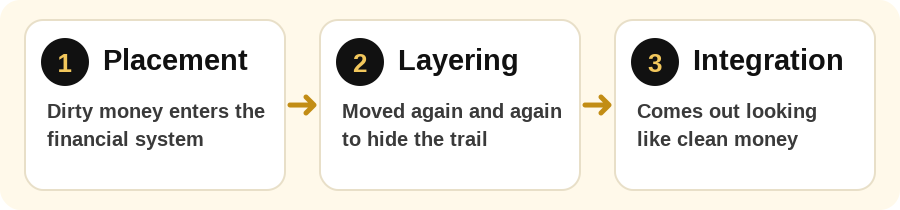
- Placement. The dirty money first enters the financial system, for example when a scam victim’s payment lands in an ordinary account.
- Layering. The money is moved again and again, between accounts, banks, apps and countries, until the trail is hard to follow. This is where mules do their work.
- Integration. The money comes out the other end looking clean, maybe as a car, a property or “business income”.
Each mule usually handles a fairly modest sum. That is the point. Lots of small movements are harder to spot than one big one.
How the money moves
Funds from fraud or other crime arrive in the mule’s account, often within minutes of each other, and are quickly sent on: by bank transfer, cash withdrawal, money transfer or crypto. Moving the money through several accounts makes the trail longer and harder to follow. By the time a victim reports a scam, the money may have passed through several mules and left the country.
Who gets recruited, and how
Mostly young people. Cifas and UK Finance data for the first half of 2023 showed that people under 21 accounted for 23% of cases on the Cifas National Fraud Database with signs of money mule activity, and people up to the age of 30 accounted for 64%. The “job” often has a friendly title such as payment processing agent or money transfer assistant.
It is not only the young, though. People in financial trouble, jobseekers and victims of romance scams get pulled in too, sometimes without understanding what they have been drawn into.
Recruitment channels
Recruiters use social media posts promising quick money, fake job adverts for “payment processors”, messages that claim you can earn commission, romance scams in which a partner asks to “use your account”, and approaches to students, newcomers and people in financial difficulty. Some target teenagers through games and chat apps. Others pay existing account holders to rent out their accounts.
Three kinds of mule
- Unwitting mules believe they are doing a real job or helping a friend or partner and do not realise the money is criminal.
- Witting mules suspect or know the money is illicit but go along for a fee.
- Complicit mules are part of the criminal group and open accounts specifically to move funds.
The law does not treat all three the same, but even an unwitting mule can face account closure and questions from investigators, and ignoring obvious warning signs can count as recklessness in many countries.
Where remittance fits in
Cross-border payments are attractive to criminals because money can move between countries quickly. A mule might be told to send the cash onward by bank transfer, a money transfer app or cash pickup. Providers know this, so their systems watch for odd patterns.
Here is the practical version. If someone you do not know well asks you to receive money and forward it, even “for a friend abroad”, treat it as a red flag. A genuine friend does not need you to be the middleman.
The consequences are real
Under UK law, money laundering can carry up to 14 years in prison. Long before a court gets involved, banks may close the account and share the details with fraud prevention services. That can make it harder to open a bank account, get a loan or even sign a phone contract for years. Laws differ by country, but handling the proceeds of crime is an offence almost everywhere, and “I did not ask where it came from” may not protect you.
The legal position
Beyond the UK, laws differ, but in many countries it is an offence to knowingly or recklessly acquire, use or transfer criminal property. Prosecutors can use money laundering, fraud conspiracy and similar charges, and a conviction brings a criminal record that affects jobs, travel and credit. Check the rules in your own country.
Case study: the “easy job” that was not
Illustrative scenario. This is a composite example written to explain a pattern. It does not describe a real person or company.
Daniel, a 20-year-old student, sees an online advert for a “payments assistant” job. The employer asks him to receive transfers into his own bank account, keep 10% and forward the rest by bank transfer or crypto. The first payment arrives and he sends it on, pleased with the easy money.
Two weeks later his bank freezes and closes his account. The money he received came from fraud victims, and he now faces questions from the bank and investigators.
The red flags: a job that needs no experience, payment to a personal account, a cut of the money, instructions to move funds quickly and requests for secrecy.
What to do: never use your account to move other people’s money, and if you have already done so, stop and tell your bank and the police straight away.
Red flags worth remembering
- You are offered money just for letting funds pass through your account.
- You are asked to keep a percentage and send the rest.
- You are told to move the money by transfer, gift card or crypto.
- There is no interview, contract or company you can check.
- You are asked to keep it secret from your bank.
- The money comes from someone you do not know, with a rushed explanation.
If you think you are already involved
- Stop moving money straight away.
- Keep the messages and payment details. Do not delete them.
- Tell your bank or payment provider.
- Report it to the police or your national fraud reporting service. In the UK, the campaign site moneymules.co.uk explains what to do.
- Cut off contact with the recruiter.
Acting quickly and honestly usually matters. If you are worried about your legal position, speak to a qualified lawyer.
Protecting young people
Parents, teachers and employers can help by explaining that nobody legitimate asks you to receive and forward money for a commission. Encourage young people to ask before sharing bank details, to avoid “easy money” offers and to speak up quickly if they have already helped. Early reporting reduces the harm and shows good faith.
How compliance teams spot mules
If you run or work for a payment or remittance business, this is where the day job happens. Teams combine several signals: how new the account is, how quickly money comes in and goes out, whether many unrelated senders pay one person, and whether customer details match device and location data.
Good procedures turn these signals into clear steps staff can follow. Our Business Hub explains the basics, and our consulting services include AML policies, risk assessments and training.
Practical controls for firms
- Monitor new accounts for quick in-and-out flows and little retained balance.
- Link accounts that share devices, addresses or phone numbers.
- Look for profiles that do not match the activity, such as a student receiving many large payments.
- Check for several unrelated senders paying one account.
- Train staff to ask polite questions and to report concerns.
- Share intelligence with industry bodies where the law allows.
See our fraud typologies guide and AML guide.
Key terms in this article
- Money mule: someone who passes on money for criminals, knowingly or not.
- Money laundering: disguising the criminal origin of money.
- Placement, layering, integration: the three stages of laundering.
- Structuring: splitting payments to avoid checks.
- Transaction monitoring: automated scanning of payments.
- SAR: a suspicious activity report to the authorities.
Frequently asked questions
Can I be a mule without knowing it? Yes, which is why checking before you accept any request to move money for others is so important.
What if I already sent money on? Stop, keep all messages and records and contact your bank and the police.
Is it safe to lend my account to a friend? No. Do not let anyone else use your account, even briefly.
Sources and further reading
- Cifas: young people acting as money mules
- AML Intelligence: UK money mule figures, 2023
- UK Finance: educating families about money muling
- OCCRP: UK police warning on money mulling
Official sources:
- Cifas: lesson plans to stop young adults becoming money mules (July 2023 data)
- UK Finance: Don’t Be Fooled campaign and Cifas data
- FCA: money mule activity and cashing out findings
- Action Fraud: report fraud in the UK
- US Federal Trade Commission: consumer advice
General information only, not legal, tax or financial advice. Rules differ by country and change, so check the official sources linked above.