
The 1% US Remittance Tax: Who Pays It, Who Doesn’t, and What It Really Costs

By RemitInsights Editorial · Updated 17 November 2026 · 6 min read

If you send money home from the United States, you may have noticed a new line at checkout. Since 1 January 2026, a federal tax of 1% applies to some international transfers. It looks small, but it is surprisingly confusing in practice, so let’s clear it up.
In short: The US 1% remittance tax applies to certain transfers from the United States. Check your receipt for a separate tax line and compare the total cost of different funding methods.
What the tax is
The 1% remittance tax was created by the 2025 US tax law known as the One Big Beautiful Bill Act. It applies to certain transfers of money from the United States to people abroad. The sender pays it; the company handling the transfer collects it and passes it on to the IRS.
When you pay it, and when you don’t
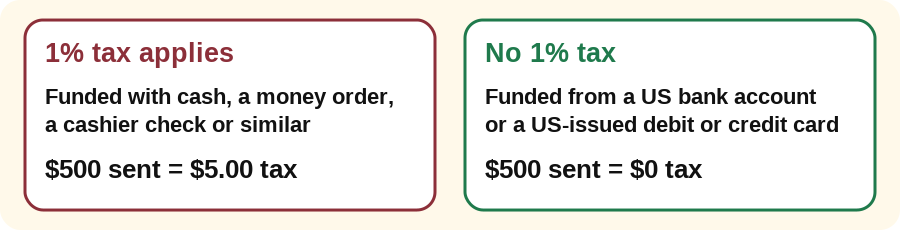
The tax is aimed at transfers paid for with cash, a money order, a cashier’s check or a similar physical payment. Transfers funded from a US bank account, or with a debit or credit card issued in the United States, are exempt. It applies whatever the sender’s citizenship, and money sent into the United States is not covered.
A quick example
| How you pay | Amount sent | 1% tax | Fees and exchange margin |
|---|---|---|---|
| Cash at an agent location | $500 | $5.00 | Still apply |
| US bank account | $500 | $0 | Still apply |
| US-issued debit card | $500 | $0 | Still apply |
The 1% is not the only cost. The provider’s fee and the exchange-rate margin still apply, and the margin is often the bigger number. Our true cost calculator shows what you really lose. If you pay the tax, add it to the “provider fee” box.
A fuller example with all the costs
Here is a made-up example, so the numbers are for illustration only. Say you send $300 and the provider charges a $4.00 fee and a 2% exchange-rate margin.
| Cost | Paid in cash | Paid from a US bank account |
|---|---|---|
| 1% remittance tax | $3.00 | $0.00 |
| Provider fee | $4.00 | $4.00 |
| Exchange-rate margin (2%) | $6.00 | $6.00 |
| Total cost | $13.00 (about 4.3%) | $10.00 (about 3.3%) |
The point is not that cash is always worse. Some cash services have lower fees or better rates. The point is to compare the full cost, not just the headline fee.
What if you don’t use a bank account?
Plenty of people send cash, either because they prefer it or because they do not have a bank account. Some providers accept US-issued prepaid or debit cards, which may be exempt, but you should ask the provider whether your card qualifies. Compare the total cost before changing how you send. We are not tax or immigration advisers, so for personal questions speak to a qualified professional.
Myths worth clearing up
- “Only non-citizens pay.” No. The tax depends on how the transfer is funded, not on who sends it.
- “Bank transfers are taxed too.” Transfers funded from a US bank account are exempt.
- “The provider keeps the 1%.” No. The provider collects it for the IRS and passes it on.
- “It also applies to money sent into the US.” No. It covers transfers going out of the country.
Questions to ask before you send
- Is the 1% tax shown as a separate line?
- What exactly counts as an exempt payment method for this provider?
- What exchange rate will my recipient get, and what is the fee?
- Will I get a receipt that shows the tax?
This is still changing
The IRS has published proposed rules explaining which transfers are covered, and providers may update their terms as the rules are finalised. Treat any article, including this one, as a snapshot, and check the IRS and your provider for the latest.
What it means for providers
Providers must identify which transfers are covered, collect the tax when the sender uses a covered payment method, show it clearly at checkout and pay it over to the IRS under the rules the IRS sets. That affects systems, agent training and recordkeeping: record how each transfer was funded, update receipts and train staff to explain the charge. Mistakes can lead to customer complaints and penalties. The tax also gives customers a reason to move from cash agents to digital channels, which affects product plans and agent networks. See our AML guide for how recordkeeping fits with other duties, or our services if you need help documenting the changes.
How to see whether you paid the tax
The tax should appear as a separate line on your receipt or in the checkout summary, along with the fee, exchange rate and the amount your recipient will receive. If you cannot find it, ask the provider before you pay. Keep receipts, because they show how the transfer was funded and what you were charged.
The recipient’s view
The sender pays the tax, so the recipient does not pay it and does not need to do anything. Remember, though, that the tax is only one part of the cost. The amount your recipient receives also depends on the exchange rate, so compare the total. Our mid-market guide explains how to check it.
Case study: two ways to send the same amount
Illustrative scenario. This is a composite example. It does not describe a real person or company.
Luis sends 400 dollars every month by paying cash at an agent location. After the tax starts he notices an extra 4 dollars on each receipt. A coworker tells him that transfers funded from a US bank account or a US-issued debit card are exempt, so he opens an account and compares three quotes. He finds an option with a lower exchange margin, no tax and a similar delivery time. His neighbour Rosa prefers cash because she has no bank account, so she compares agent locations and picks the one with the best rate. Both made informed choices because they looked at the whole cost.
Planning around the tax
- Compare the total cost, not just the tax line.
- If a bank account or US-issued card is practical and safe for you, check whether the exempt option is cheaper.
- If cash is your best option, compare agent locations and rates.
- Never split transfers to try to avoid the tax or reporting. It can look suspicious and may cause problems.
Key terms in this article
- Remittance: money sent across borders, often to family.
- Excise tax: a tax on a specific type of transaction.
- Cashier’s check: a check issued by a bank, paid for in advance.
- Money order: a prepaid payment slip bought with cash.
Legal basis and current status
The tax comes from section 4475 of the Internal Revenue Code, added by the One Big Beautiful Bill Act (Public Law 119-21). It is 1% of the amount of a covered transfer, applies to transfers made after 31 December 2025 and is paid by the sender, but only where the sender gives the provider cash, a money order, a cashier’s check or a similar physical instrument.
Providers collect the tax, make semimonthly deposits and file quarterly returns. The IRS issued Notice 2025-55, which gave providers temporary relief from failure-to-deposit penalties for the first three quarters of 2026, and proposed regulations were published in April 2026. Regulations can change, so check the IRS website for the current status before you rely on this page.
Frequently asked questions
Does the tax apply to money sent to the US? No, it applies to transfers from the United States to recipients abroad.
Is the rate going to change? Tax rules can change, so check the official sources linked on this page and your provider’s notices.
Where can I read about other corridors? See our corridor guides and taxes and reporting guide.
Sources and further reading
- IRS (official site and guidance)
- Greenback Tax Services: IRS proposed regulations
- Ria Money Transfer: what to know
- Western Union: US remittance tax
Official sources:
General information only, not legal, tax or financial advice. Rules differ by country and change, so check the official sources linked above.